Solder, Swap, Repeat: Inside the Vape Modding Scene Where Cloud Chasers Became Hardware Hackers
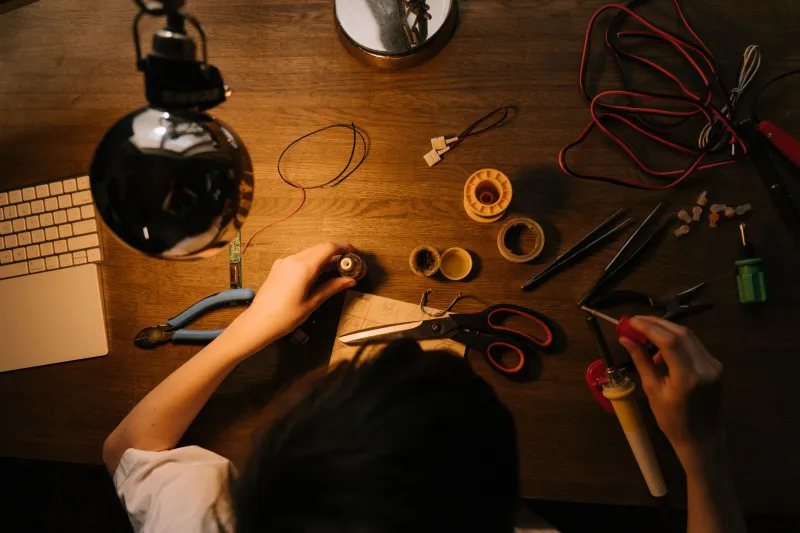
There's a workbench in a garage in Austin, Texas, covered in flux paste, copper wire, and at least three half-disassembled vape mods. The guy behind it, who goes by WattsUpDoc on Reddit, isn't a professional engineer. He's a 31-year-old IT support tech who started tinkering with his first box mod about four years ago because he was annoyed by the menu navigation. Now he's building custom regulated mods from scratch using 3D-printed enclosures and sourced MOSFET components.
"It started as a fix," he told us over Discord. "Then it became a hobby. Now it's basically the only way I want to interact with vaping."
He's not alone. Across Reddit communities, YouTube channels, and tight-knit Discord servers, a quietly thriving subculture has taken root — one where vapers aren't just consumers of hardware, but its architects. And if you've spent any time in the PC building or mechanical keyboard scenes, the whole thing is going to feel very familiar.
The DNA of a DIY Movement
The parallel to PC modding isn't accidental. A lot of the people now deep in vape hardware customization came up through those exact communities. The same itch that drove someone to do a custom water-cooling loop or hand-lube sixty-eight switches on a Tofu65 eventually found a new outlet in vape hardware.
Both hobbies share the same core appeal: mass-market products that are good enough but never quite yours. A stock mod from a major manufacturer is optimized for broad appeal — conservative safety margins, simplified UI, aesthetics designed by committee. For a certain kind of enthusiast, that's an invitation, not a limitation.
"Commercial mods are like pre-built PCs," says KelvinCoilworks, a modder based in Portland with a YouTube channel approaching 40,000 subscribers. "They work great. But the second you crack one open and see what's actually in there, you start thinking about what you'd do differently."
What they do differently runs the gamut. On the simpler end, you've got aesthetic mods — custom resin panels, laser-etched designs, swapped LED colors. Go deeper and you're looking at people reflashing firmware on DNA or YiHi chips to adjust wattage curves, swapping out 510 connectors for better conductivity, or bypassing stock battery management systems entirely to squeeze out performance headroom that manufacturers deliberately left on the table for safety compliance reasons.
The Knowledge Stack That Made It Possible
None of this would be happening at scale without the internet doing what it does best: democratizing technical knowledge at a pace traditional gatekeepers can't keep up with.
YouTube has been a massive driver. Channels dedicated to coil building, ohm's law explainers, and step-by-step mod teardowns have accumulated millions of combined views. The barrier to understanding the basics of battery chemistry, regulated vs. unregulated circuits, and safe resistance ranges has dropped dramatically. What once required knowing someone in a local vape shop — the kind of greybeard who'd been doing mechanical mods since the early 2010s — is now a search query away.
Reddit communities like r/DIY_eJuice and various vape hardware subreddits function as living wikis and peer-review boards simultaneously. Post a build, and within hours you'll have experienced modders flagging potential shorts, questioning your wire gauge math, or pointing you toward a better PTFE source. It's the same knowledge-sharing culture that made r/MechanicalKeyboards a launchpad for an entire artisan keycap economy.
"The community is genuinely rigorous," says WattsUpDoc. "People will call you out fast if your build is unsafe. There's a real culture of accountability around it."
Tools of the Trade
So what does a serious vape modder's toolkit actually look like? It's more accessible than you might think — and more overlapping with other maker hobbies than you'd expect.
- Soldering station — A temperature-controlled iron is non-negotiable. Hakko and TS100-style irons are community favorites.
- Multimeter — Constantly checking resistance, voltage, and continuity. Absolute baseline gear.
- Ohm reader — Dedicated coil resistance checker, especially important for mechanical mod builds where there's no onboard protection.
- 3D printer — Increasingly common for custom enclosures. Resin printers are popular for high-detail aesthetic work; FDM for functional housings.
- Battery charger with discharge testing — Knowing your actual cell capacity and internal resistance matters a lot when you're pushing hardware harder than factory specs intend.
- Oscilloscope — For the deep-end nerds diagnosing waveform behavior on regulated chips. Definitely optional, but it shows up on workbenches more than you'd think.
The materials side gets creative fast. Stabilized wood, carbon fiber sheets, custom acrylics, even salvaged aluminum — modders are sourcing enclosure materials from woodworking suppliers, knife-making shops, and aerospace surplus vendors. The crossover with knife-making and pen-turning communities is surprisingly real.
The Risk Conversation Nobody Skips
It would be irresponsible to cover this scene without being straight about the risks, and honestly, the modding community itself doesn't shy away from them.
Lithium batteries are unforgiving. An unregulated mechanical mod with an improperly built coil at too-low resistance isn't a quirky science experiment — it's a potential thermal runaway event. Battery venting, shorts, and fires are real consequences of uninformed builds. The community's insistence on understanding Ohm's Law before touching a mech mod isn't gatekeeping; it's basic harm reduction.
"I always tell people: learn the theory before you touch the hardware," says KelvinCoilworks. "If you can't explain why your build is safe, you don't build it yet."
Regulated mods are significantly more forgiving thanks to onboard protections, but reflashing firmware or bypassing safety circuits reintroduces risk. The responsible end of this community treats safety documentation with the same seriousness that amateur radio operators treat RF regulations — because the consequences of getting it wrong are physical, not just digital.
Where the Scene Is Headed
What's interesting about the current moment is how the vape modding world is starting to develop the same kind of tiered economy that mechanical keyboards did. There are now modders building small-batch custom devices and selling them through private Discord channels and Etsy-adjacent storefronts — the equivalent of artisan keycap makers or custom PCB designers. Some of these one-off builds are trading for serious money among collectors.
At the same time, accessibility keeps improving. Better documentation, cheaper 3D printers, and a more mature community knowledge base mean the on-ramp is less steep than it was five years ago. The scene that once required deep technical background is increasingly welcoming to curious beginners who are willing to do the homework.
For the enthusiasts already deep in it, that's exciting rather than threatening. More people in the tent means more innovation, more shared knowledge, and — if the mechanical keyboard scene is any guide — an eventual mainstream moment that nobody in the current underground quite sees coming yet.
WattsUpDoc put it well: "Every person who opens up their mod and gets curious is a potential builder. We were all just users once."
The workbench in Austin stays messy. The solder keeps flowing.