Endgame Setups: Inside the Vape Customization Scene That's Basically Mechanical Keyboards With Clouds
Anyone who's fallen down the mechanical keyboard rabbit hole knows the feeling. You started because you wanted something that felt better to type on. Then you discovered switch varieties. Then keycap sets. Then case materials and sound dampening foam and custom stabilizers. Then you were spending Saturday mornings watching artisan keycap drops like they were Supreme releases, and somehow that felt completely reasonable.
Now meet the vape customization scene. It's not the same hobby, but it speaks the same language fluently.
Form Factor Is the Feature
There's a persistent assumption — mostly from people outside the vaping hobby — that the community is primarily performance-driven. Wattage, coil resistance, airflow dynamics. And sure, that stuff matters to a lot of people. But there's an equally passionate segment of this community for whom the hardware is first and foremost an aesthetic object. Something to be displayed, photographed, and curated.
"I have setups I basically never use," admits Trevor, a collector from Minneapolis who maintains what he calls a "vape shelf" — a dedicated display case housing twelve different mods, each paired with a specific tank and drip tip combination. "They're just too nice to actually carry around. I built them the same way I'd put together a display keyboard. The point is the object itself."
This framing — the device as collectible, as curated personal expression — is exactly what drives the mechanical keyboard hobby's most dedicated participants. And the parallels go deeper than attitude.
The Drip Tip as Artisan Keycap
If you want to understand vape customization culture, start with the drip tip. It's the mouthpiece — the part your lips actually touch — and it's almost universally swappable across compatible devices. That interchangeability has turned the drip tip into the hobby's equivalent of an artisan keycap: a small, highly visible component that serves as a canvas for absurd levels of craft.
Makers on Etsy, Instagram, and dedicated vape forums produce drip tips in hand-turned stabilized wood, resin pours with embedded artwork, machined aluminum in colorways that reference gaming aesthetics, and materials so unusual (antler, meteorite fragments, Damascus steel) that they've become conversation pieces independent of the device they're attached to.
Limited runs sell out in minutes. Waiting lists form. Secondary market prices spike. Sound familiar?
"I paid more for a single drip tip than I did for the mod it's sitting on," says Priya, a collector from Chicago who has amassed over sixty drip tips in the past three years. "And I don't feel weird about it at all. It's the piece you look at every time you pick up the device. Why wouldn't you want it to be perfect?"
Skins, Panels, and the Mod as Canvas
Beyond the drip tip, the customization ecosystem branches in several directions. Mod skins — precision-cut vinyl wraps applied to device bodies — have their own dedicated market, with designers producing everything from carbon fiber textures to pixel art patterns to licensed gaming and anime references. Applying a skin cleanly has become its own skill, with tutorials circulating online that mirror the precision of keyboard case painting guides.
For box mods with removable panels, the options escalate further. Custom-machined aluminum and carbon fiber panels are available from small-batch manufacturers, often produced in limited colorways that function essentially as collector's editions. Some modders go further, commissioning hand-engraved or laser-etched designs that turn the device body into something closer to jewelry than consumer electronics.
Then there are the tanks. While most commercial tanks are finished in standard colorways, aftermarket options and limited-edition manufacturer releases have introduced anodized aluminum in gradient finishes, DLC-coated stainless in matte black, and even hand-blown glass sections that replace standard pyrex with artisan alternatives. The result is a device that looks less like a product off a shelf and more like something assembled with deliberate intention.
The Photography Meta
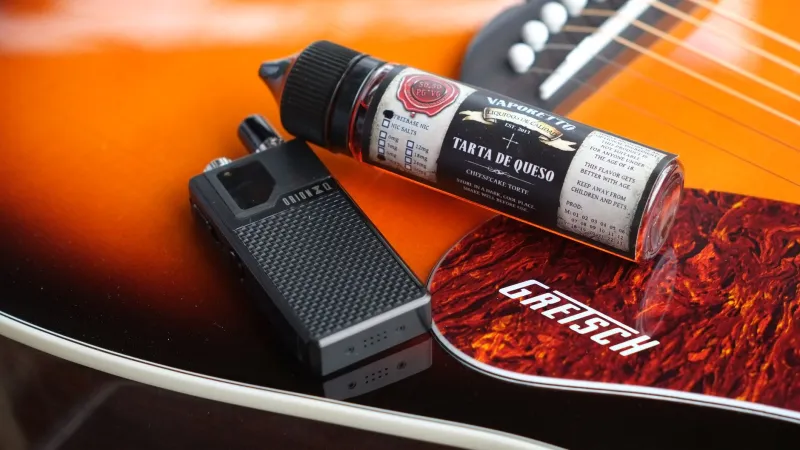
One of the clearest signals that vape customization has developed its own aesthetic culture is the emergence of a dedicated photography scene around setups. Instagram accounts with tens of thousands of followers are built entirely around styled hardware photography — mods arranged on wooden surfaces, lit dramatically, paired with complementary objects the way a fashion photographer would style an accessory shoot.
This is the "battlestation" culture of the vaping world, and it operates on the same logic. Your setup is a statement. The way you photograph it and present it to the community is part of the hobby itself. Subreddits dedicated to this content thrive, and the most upvoted posts are rarely about the most powerful devices — they're about the most visually cohesive ones.
"The photography is how you share the work," says Trevor. "I spend time on lighting and composition because I want people to see what I was going for with a particular build. It's the same reason someone would post a finished keyboard build with a nice photo instead of just a description."
Why This Community Values Beauty
The deeper question is why this matters — why a community nominally organized around a functional activity has developed such a rich visual culture. Part of it is simply that personal devices invite personalization. Your phone, your laptop, your keyboard — these are things you interact with constantly, and making them feel like yours is a natural human impulse.
But there's something more specific happening in the vape customization scene. For a community that has spent years operating under regulatory pressure and cultural skepticism, there's an assertion of legitimacy in treating the hardware as worthy of craft and curation. These aren't disposable objects. They're things people have invested time, money, and genuine creative energy into.
That's not so different from what mechanical keyboard enthusiasts are doing when they spend months sourcing parts for a build. The hobby says: this thing I do is worth doing beautifully. The community agrees. The setups get more elaborate. The drip tips get more intricate. The photography gets better.
Endgame, it turns out, looks the same no matter which hobby you're in.